RoWAC calls for stronger action against Wye pollution

RoWAC calls for stronger action against Wye pollution
The Ross on Wye Angling Club (RoWAC) is bitterly disappointed with the Environment Agency’s Diffuse Water Pollution Plan (DWPP) for the River Wye Special Area of Conservation (SAC). This plan is totally inadequate to effectively address and reverse the pollution crisis the River Wye now faces. We join a growing chorus of voices in calling for the urgent declaration of a cross-border Water Protection Zone now to save the River Wye, and the strongest programme of measures to be implemented in the upcoming revisions of the River Basin Management Plans for the Wye in England and Wales that will specifically target and reverse agricultural and waste-water pollution. We also call for enforcement action against polluters breaking the law, and financial support for those farmers keen transition to river-friendly, regenerative farming along the Wye.
The Ross on Wye Angling Club and the River Wye
The Ross on Wye Angling Club was established in 1912, and has been caring for about 5.5 miles of the River Wye close to Ross on Wye for well over a century.  These days the Club provides exquisite angling opportunities for 350 members, and attracts hundreds more day-ticket holding anglers every year from around the country to fish the stretch that flows through out beautiful town. These visitors join the thousands of day-trippers, including walkers and canoeists, who come to Ross to enjoy our mighty River Wye every summer, some hoping to spot a kingfisher or even an elusive otter. It is fair to say that the health of ‘Britain’s favourite river’ plays a fundamental role in our local economy, and is crucial to the health and well-being of many local residents, including our Club members, who spend hours and hours enjoying the river.
So one can understand why in recent years we have been appalled, outraged and devastated by the terrible impacts of uncontrolled pollution on the health of our much-valued river ecosystem. This is largely from agricultural phosphate run-off further upstream, but also to some degree from ubiquitous, poorly-managed waste water treatment in the catchment. We see and smell the pollution on a daily basis – and it hurts our hearts.

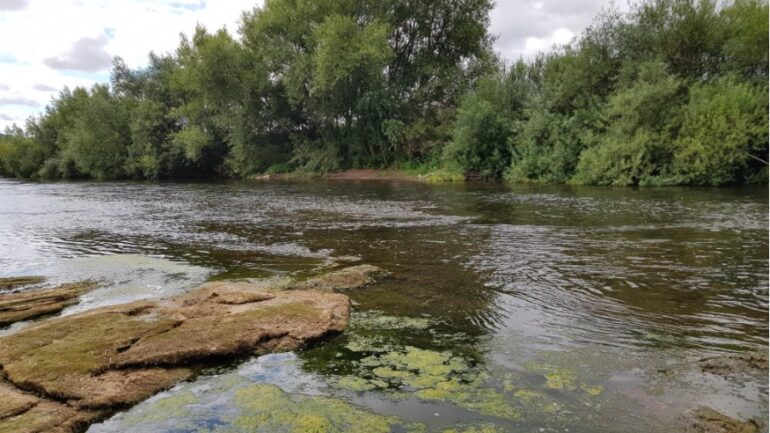
The days of lush, emerald mats of Ranunculus – a summer-flowering water plant – sprinkled with tiny, white blooms stretching from bank to bank have been lost in just the last few years. Thick algal pea-soupers caused by high phosphates and other nutrients now plague the Wye in Spring and Summer, darken the water and smother the river bed with slime, cutting off essential light for the young, sprouting Ranunculus plants. In good years, small patches of Ranunculus do still survive in our stretch of the river when the water runs clear, but these years are becoming few and far between. Repeated smothering will eventually kill the remaining Ranunculus patches for good.
This would be disastrous. Ranunculus, and the clean stones piled on river bed, provide essential complex habitats for a myriad of invertebrates, that provide food for our abundant fish, which in turn feed our kingfishers, goosanders, egrets, herons and otter. Once the Ranunculus has gone and all that is left is slime-smothered stones, the system will likely collapse.
 Right now the River Wye is still alive – along our stretches our members have recorded over 80 species of birds, including good populations of the fish-eating species, as well as water shrew and otter. Course fishing is excellent, with impressive catches of pristine barbel and chub landed regularly through the summer, and yet more chub in the winter, with one angler catching over 60lb of chub in just a few hours this last weekend. The river is not yet dead, and still has the abundance of life it will need to recover, if only we give it a chance.
Sadly, there is a casualty whose future is far from certain. Like almost everywhere else in the UK, our Atlantic Salmon population is in steep decline. Long gone are the days when hundreds of huge salmon were caught and landed along our Club stretches each year. The last ‘good’ year for the Club was in 2017 when 44 salmon were caught, but last season was the first on record that our salmon anglers failed to land a single ‘King of the River’ on club waters. This most recent season was marginally better, with 4 salmon having been landed in the Club waters by season end in October.
The decline of Atlantic salmon is an ocean-wide phenomena, with North Atlantic salmon populations having suffered a 70% decline in recent decades, largely due to a combination of over-exploitation at sea, climate change impacting habitats and prey, as well as river obstructions and pollution impacting their freshwater spawning habitats. Recent research has shown that the young salmon ‘smolts’ heading out to sea are more likely to survive and return to their freshwater breeding habitats as adults if, as youngsters they are fat, fit and well-fed before they leave the river. If we continue to smother their River Wye feeding grounds with phosphate-fuelled algae and slime, their chances of survival are slim in a world where the odds are already stacked against them.
The River Wye is still alive, but we need to take bold action right now to ensure that it survives to benefit wildlife and people for generations to come.

Dr Peter Richardson
Club Secretary

Recent Comments